About Me

My photo
El Paso, Texas, United States
I photograph what inspires me. This could be just about anything as I am a person of many interests and look for the beauty in everything that I see and one of the first thoughts is how I can photograph a subect to portray it how I see it. This could be rendered as HDR, traditional portrait, or even using photoshop techniques.
Showing posts with label Raney Photography. Show all posts

April 24, 2011

Tip - Applying the Rule of Thirds

One of the most fundamental aspects of photography is composition.  When talking about compostion, there are many elements of design that make up this as a whole.  You have line, form, shape, color, pattern, rhythm, etc.  Of all of these different elements, the most fundamental is the "Rule of Thirds."

I give a base diagram for the rule of thirds below, but essentially this fundamental element of design plays on the visual aspect of the photograph.  As a viewer looks at a photo, the natural tendency for the eye is to look at certain points of the image first.  Asking anyone on the street, they would probably tell you that the first place to look is at the center, but they would be wrong.


Using the rule of thirds, you would basically split the horizontal and vertical portions of the frame into thirds, as shown above.  There are four (4) points on the diagram that intersect (vertical and horizontal lines cross); the upper left, the upper right, the lower left, and the lower right.  These are the points that a viewer's eye naturally is drawn to when first looking at a photograph.  These are the main points to concentrate on, but typically anywhere along the lines either vertically or horizontally that the primary focus of your photograph should be placed.  There are exceptions to this rule, but let's stick to the basics for now.  If you are taking a portrait of someone, you would want to place him/her along the dividing lines of the frame.  This will create a more visual pleasing photo to look at.

As I have said before, this is probably one of the most fundamental rules of photography.  With that being said, it is also the most unused element of design.  I would recommend a training program of sorts for the amateur photographers out there.  Go out and take a lot of photographs, it doesn't matter what it is, just take them.  First concentrate on what is your primary subject of focus and then apply the rule of thirds.  This fundamental can only be instilled if it is practice, much like driving a car, the more you drove a vehicle the more comfortable and confident you drove.  The same is for applying this rule.  Practice, practice, practice.  I cannot say this enough.

April 18, 2011

A Day at the Tigua Cultural Center


During a recent trip to the Tigua Cultural Center of the Ysleta del Sur Pueblo in El Paso,  I took this photo of one of the dance performances.  The Tigua Native Americans currently celebrate over 300 years of tribal history in the local area.  Below I have posted the address, phone number, and times of these social dance performances if anyone is interested in seeing.

Tigua Indian Cultural Center
305 Ya Ya Lane
El Paso, TX 79907
915-859-7700

Dance Performances:  Saturday and Sunday only - one at 11:30 a.m. and one at 1:30 p.m.

April 3, 2011

Monster Jam


These photos were actually taken during the Monster Jam event in El Paso in early March.  I have been going through about 8 gigabytes worth of photos and looking for the best ones.  This first photo is of Grave Digger jumping a pile of crushed vehicles.


This photo of the vehicle of  Iron Man jumping was one of the first of many photos that were taken.  This was one of the first few photos that I actually was able to get the camera settings just right in order to capture the subject moving focused properly while keeping the background just slightly out of focus.  This is a technique called panning and takes a good amount of practice in order to get right.


This photo is of Grave Digger the Legend.  This is also a slight use of the technique called panning but with the primary subject coming moving toward the camera slightly.  This is one of the most successful photos in respect to composition and other elements of design.


El Toro Loco is among the favorites of the El Paso people.  I would have to agree partly with the exception of Grave Digger.  Until next time.

March 27, 2011

Roses on top of Sheet Music


While working on some other photographs, I suddenly got this idea to photograph some roses.  I was not sure of how I wanted to photograph them and I remembered that I had seen a long time ago, a single rose on top of an old love letter.  I thought that why not use some sheet music instead of a letter.  After a little bit of research, I knew that I wanted to use Beethoven as the underlying music for the photograph but could not decide on which song.  I remembered that one of his solos called "Fur Elise" was about his proposal to a young girl and the song title translates literally to "For Elise."  After a few different setup positions and quite a few photographs later, I finally found a setup that worked with what I was trying to get at.  I worked different angles and different light source positions and found what I liked.  I hope that you enjoy this as much as I had taking it.

March 8, 2011

College Assignment - Song of the Wandering Aengus


I am not sure that many of you out there know that I am going to college.  I am attending The Art Institutes of Pittsburgh Online and pursuing a Bachelor of Science in Photography.  In one of my classes this past week, we were asked to listen to a poem called "The Song of the Wandering Aengus" and then take some photographs of our interpretation of the poem.  There were so many different ways the poem could be interpreted that it was almost impossible to pick just one photo to submit for the assignment.  I decided on this photograph and try to make it seem like a dream state look with everything in black and white with the exception of the strawberries and blueberries.  I tried to convey the dream like feeling in the same way we dream; keeping all the black and white out of focus and the colored items in focus with a lot of clarity.  I don't think that I felt justified in the interpretation of the poem, but with the time of year and other situations that were working against me, this was the best one that I came up with.  But in the end, I was satisfied with the outcome.

February 27, 2011

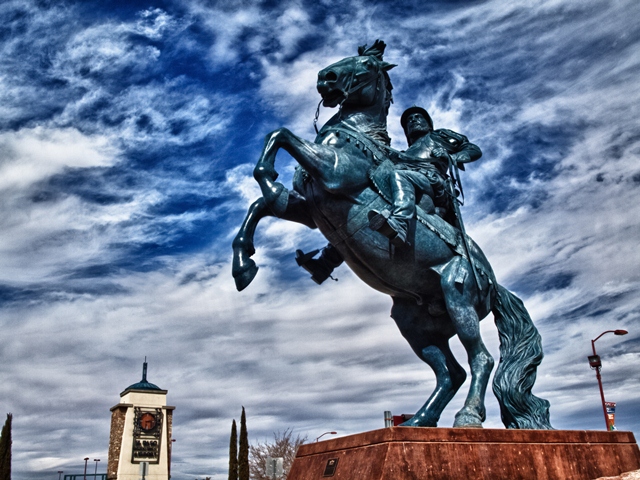
The Equestrian


The Equestrian is the world's largest bronze equestrian statue to date standing almost 40-foot tall.  It was dedicated on 21 April 2007 and the name of the artist is John Sherrill Houser (and Ethan Taliesin Houser).  This statue was originally named after Juan de Oñate (AKA Juan de y Oñate Salazar) which was a Spanish conquistador and explorer.  The stature was renamed to "The Equestrian" by the City Council in order to deter growing criticism of the sculpture.  Juan de Oñate, even by his own accounts, had subjected the people of Acoma and other pueblos to horrendous atrocities.