About Me

My photo
El Paso, Texas, United States
I photograph what inspires me. This could be just about anything as I am a person of many interests and look for the beauty in everything that I see and one of the first thoughts is how I can photograph a subect to portray it how I see it. This could be rendered as HDR, traditional portrait, or even using photoshop techniques.

February 1, 2012

Personal View on Working with Models


     There are several options to choose from for amateur and professional photographers alike when finding models to work with on photo shoot projects.  In my personal opinion, Model Mayhem has been a fairly good site in order to find these models.  You can find a wide range of models, ones with little to no experience that are trying to get their foot in the door and ones that are experienced and knows how to work with the photographer.

     I will not claim that I am all knowing about model photography but I have seen some good points and bad points when working with models.  First thing that I do when looking for a model is to know what type of photo shoot that I want to do, the concept, what type of clothing I would like for the model to wear, how their hair should be, etc.  Then I will contact the model and ask them if they would be interested in working with me on a photo shoot project that I have coming up.  I always try to give the model at least a week prior to the photo shoot.  I will also research each model that I am considering prior to sending them a message.  I try to find models that will fit the look of what I am trying to go for and not just choose any model that will work with me.  Below are some recommendations for Do's and Don'ts when looking for models.
  • Do look for a model that compliments the photo shoot project
  • Do look at each model's portfolio to get a feel of their experience
  • Do ask the model what type of compensation they are looking for (TFCD/TFP, Paid)
  • Do be upfront about your project concept so they can get an idea of what to expect
  • Do let them know the location, directions if needed, time they would be expected, and your contact info so that they can call if they maybe running late or have trouble finding the location

  • Don't choose a model that asks to be paid and also a CD of all images taken, in my opinion this is a concept of double dipping, asking to be paid is one thing or asking for TFCD is another, there is no consideration of your time by the models even though it takes you much more time to photograph the model and process the images where the model only has to model for the photo shoot
  • Don't be afraid to work with models that are wanting to break into the industry, of course this will come with a learning curve for you as the model will look to you for guidance of what to do, how to stand, what to do with their hands, and so on (This will require some research on your part of how to do posing and what to look for)
  • Don't forget to have a model release for the model to sign either before or after the photo shoot
     As a photographer, the main point that I have come to is to not let the model dictate how the photo shoot is to go and/or who gets paid for the photo shoot.  A photographer can still make a living without having to photograph models, but a model cannot make a living without a photographer to take pictures of them.  So don't be afraid to stand your ground and make sure that each model understands what guidelines you will go by.  There is much more that I would like to write about this and it may be another post on another day to come.  As always keep practicing and in the words of Henri Cartier-Bresson, "Your first 10,000 photographs are your worst."

December 14, 2011

How Time Flies

I can't believe that this year is almost over.  I have met wonderful new people and taken so many great photos throughout this year.  I think what has been the most fun for me (besides photography) is the meeting of the new people.  I do not look at these individuals as clients where I am there to do a job for them.  I like to get to know them, what are their likes and dislikes, so as to complement their style into the photos.  This, at least for me, makes for a better photograph.

This coming Saturday I am conducting a photo shoot for some local models.  This is a free for all where I can get models and other photographers to meet each other then go out and take some pics.  I know what I am capable of doing when it comes to photographer, but for me it is so much more enjoyable to help other photographers learn about different styles.  It is also a good way to network these individuals.  They say that the best advertisement is by word of mouth.  So I need to be on my "A" game with these upcoming photographers and models so they know that I can help them.

I have added a photo below to show one of my recent photo shoots.  It is of the daughter and her mom after seeing this photo is asking me to take her High School Senior Photos this coming year.  Until next time, keep on practicing.

December 6, 2011

To Know or Not To Know


I have done a couple of maternity photo shoots in the past and recently I was given the pleasure to do another one which was by far one of my best maternity photo shoots to date.  I don't want to offend anyone out there, but I have found that there are a lot of females that are timid around a male photographer and prefer a female photographer for these types of photo shoots.

These photos are of Jose and Christina, which were very easy to work with as well as to become very comfortable around.  What did I mean by the title of this post, "To Know or Not To Know" is what I am getting to explain now.  After I had taken these photos, Christina found me on Facebook and liked my page without me asking and said that was extremely pleased with the photos and looked forward to working with me in the future once their baby was born.  I do not like to pry into others lives when I am working with them.  Come to find out that Christina is actually Christina Zapata Cuervo and is one of the main reporters for Univision 26 in El Paso.

Now comes the question.  Do you think as a photographer that you would have treated the situation differently if you knew ahead of time that one of your clients was a public figure or celebrity?  I looked back at this situation and do not think that I would have.  I prefer not to know so as to ensure that I am concentrating on the photography and not about the person.  This is my take on it.  Until next time, keep on practicing.

Raney

November 29, 2011

Why use an External Flash (Part 2)


I wanted to provide some additional information and example from my previous post.  Using an external flash has its pros and cons as with just about every other piece of equipment used in photography.  Another added benefit is that using an external flash during sunsets can allow you to capture the deeply saturated colors of the sky while capturing your subject at the same time.  Also by using the external flash, your shutter speed can be kept above 1/125 which will help keep the primary focal point (your subject) from being blurred and keeps it sharp.

I had the opportunity recently to have the lovely subject Kelly (above) that wanted to have some college graduation photos done and wanted some of them to be with the sunset.  Anyone that has been in El Paso knows that having a sky with any clouds is an unusual event and we were actually lucky enough to have had just a few.  I would have liked to have had more clouds so as to bring out more color, but in hindsight this was actually just the right amount so as to not distract attention away from the subject.

For photographers, understanding light is one, if not the most important aspect in photography to learn and understand.  It is not just knowing how to capture the light coming from the sun during the day, but it is also every aspect of lighting to include using an external flash.  I could have even gone further with the photo and used the external flash on a tripod just to the right of where I was standing, but with time of the essence while taking the photo which was only about five minutes total, I did not want to take that precious time away from the subject.  You have to know when to compromise and when not to.

I hope that I have given you something to think about when using an external flash and hope that you realize that you must be diverse enough to use all available resources in order to achieve the desired results for your clients.

As an additional note, after the client seen the final photo ordered many more prints for family members and friends which allowed me to gain a good profit from the photo session.  If you learn, you will eventually profit from your experience whether expecting to or not.  Until the next time, keep on practicing.

Raney

November 17, 2011

Why use an External Flash


There are "Photographers" and "Fauxtographers" everywhere you go.  One of the areas that separate them is knowing when and how to use an external flash when shooting.  This is not saying that if you do not use a flash that you are not a photographer and I do not want to start contraversy with others in my statement.  But there are certain instances that when using a flash will greatly improve your image and provide the right lighting in order to flatter your subject.

I am extremely opposed to using the built in flash that comes standard with cameras, but have been known to use it as a last choice when my external flash is not working.  I currently use a 430EX external flash when I need it and contrary to popular belief, a flash is not only for shooting inside or when it is dark outside.  As you can see in the above photo, it is toward the middle part of the day around 10:30-11:00am and I still used my flash.  The reason I use the flash was to provide enough fill light on the subject since the sun is behind the left side of the tree and would have had a great amount of shadows fall on the subject.  By doing this, I give just enough power to the flash (current photo was diffused lighting at 1/4 power) giving the appropriate lighting to the subject, at the same time able to use a fast enough shutter speed to not have a completely washed out sky and able to even pull in some of the blues from the sky in the image.

This is not the easiest thing in the world to learn and takes a lot of practice in order to estimate the amount of light needed in different scenarios.  I am not perfect in this aspect either and this set-up even took me about 2-3 tries to adjust the power and shutter speed to get the look I was after.

I hope that this has helped you understand some situations that you could use a flash and why it is needed.  It has been awhile since my last post and was actually determining if I would continue this blog or not due to being extremely busying with work.  The main reason I am starting to write this blog again is that I really have a passion to teach others from my own experiences and to help those that are starting out in photography.

Last note that I will mention is that the one reason I do not use the built in flash on cameras is that the maximum effective distance for the flash is around six feet and even when it is used it can cause your subject to look flat by having no shadows.  I recommend that everyone should have an external flash that has the ability to adjust the power level.  Good shooting everybody and hopefully I will be able to write again soon.

Raney

April 24, 2011

Tip - Applying the Rule of Thirds

One of the most fundamental aspects of photography is composition.  When talking about compostion, there are many elements of design that make up this as a whole.  You have line, form, shape, color, pattern, rhythm, etc.  Of all of these different elements, the most fundamental is the "Rule of Thirds."

I give a base diagram for the rule of thirds below, but essentially this fundamental element of design plays on the visual aspect of the photograph.  As a viewer looks at a photo, the natural tendency for the eye is to look at certain points of the image first.  Asking anyone on the street, they would probably tell you that the first place to look is at the center, but they would be wrong.


Using the rule of thirds, you would basically split the horizontal and vertical portions of the frame into thirds, as shown above.  There are four (4) points on the diagram that intersect (vertical and horizontal lines cross); the upper left, the upper right, the lower left, and the lower right.  These are the points that a viewer's eye naturally is drawn to when first looking at a photograph.  These are the main points to concentrate on, but typically anywhere along the lines either vertically or horizontally that the primary focus of your photograph should be placed.  There are exceptions to this rule, but let's stick to the basics for now.  If you are taking a portrait of someone, you would want to place him/her along the dividing lines of the frame.  This will create a more visual pleasing photo to look at.

As I have said before, this is probably one of the most fundamental rules of photography.  With that being said, it is also the most unused element of design.  I would recommend a training program of sorts for the amateur photographers out there.  Go out and take a lot of photographs, it doesn't matter what it is, just take them.  First concentrate on what is your primary subject of focus and then apply the rule of thirds.  This fundamental can only be instilled if it is practice, much like driving a car, the more you drove a vehicle the more comfortable and confident you drove.  The same is for applying this rule.  Practice, practice, practice.  I cannot say this enough.

April 18, 2011

A Day at the Tigua Cultural Center


During a recent trip to the Tigua Cultural Center of the Ysleta del Sur Pueblo in El Paso,  I took this photo of one of the dance performances.  The Tigua Native Americans currently celebrate over 300 years of tribal history in the local area.  Below I have posted the address, phone number, and times of these social dance performances if anyone is interested in seeing.

Tigua Indian Cultural Center
305 Ya Ya Lane
El Paso, TX 79907
915-859-7700

Dance Performances:  Saturday and Sunday only - one at 11:30 a.m. and one at 1:30 p.m.

April 3, 2011

Monster Jam


These photos were actually taken during the Monster Jam event in El Paso in early March.  I have been going through about 8 gigabytes worth of photos and looking for the best ones.  This first photo is of Grave Digger jumping a pile of crushed vehicles.


This photo of the vehicle of  Iron Man jumping was one of the first of many photos that were taken.  This was one of the first few photos that I actually was able to get the camera settings just right in order to capture the subject moving focused properly while keeping the background just slightly out of focus.  This is a technique called panning and takes a good amount of practice in order to get right.


This photo is of Grave Digger the Legend.  This is also a slight use of the technique called panning but with the primary subject coming moving toward the camera slightly.  This is one of the most successful photos in respect to composition and other elements of design.


El Toro Loco is among the favorites of the El Paso people.  I would have to agree partly with the exception of Grave Digger.  Until next time.

March 27, 2011

Roses on top of Sheet Music


While working on some other photographs, I suddenly got this idea to photograph some roses.  I was not sure of how I wanted to photograph them and I remembered that I had seen a long time ago, a single rose on top of an old love letter.  I thought that why not use some sheet music instead of a letter.  After a little bit of research, I knew that I wanted to use Beethoven as the underlying music for the photograph but could not decide on which song.  I remembered that one of his solos called "Fur Elise" was about his proposal to a young girl and the song title translates literally to "For Elise."  After a few different setup positions and quite a few photographs later, I finally found a setup that worked with what I was trying to get at.  I worked different angles and different light source positions and found what I liked.  I hope that you enjoy this as much as I had taking it.

March 18, 2011

The Boxer's Mural


Downtown El Paso on the De Soto Hotel, is believed to be one of the largest boxing murals in the world.  This mural was completed in 2004 and features some boxers that are part of the El Paso's Boxing Hall of Fame.  I took this photo while conducting another assignment for college and this one deals with culture.  So I thought that I would show some of the culture of El Paso as shown in the murals around the area.

Location of this mural:

De Soto Hotel
309 E Mills Avenue
El Paso, TX 79901

March 8, 2011

College Assignment - Song of the Wandering Aengus


I am not sure that many of you out there know that I am going to college.  I am attending The Art Institutes of Pittsburgh Online and pursuing a Bachelor of Science in Photography.  In one of my classes this past week, we were asked to listen to a poem called "The Song of the Wandering Aengus" and then take some photographs of our interpretation of the poem.  There were so many different ways the poem could be interpreted that it was almost impossible to pick just one photo to submit for the assignment.  I decided on this photograph and try to make it seem like a dream state look with everything in black and white with the exception of the strawberries and blueberries.  I tried to convey the dream like feeling in the same way we dream; keeping all the black and white out of focus and the colored items in focus with a lot of clarity.  I don't think that I felt justified in the interpretation of the poem, but with the time of year and other situations that were working against me, this was the best one that I came up with.  But in the end, I was satisfied with the outcome.

February 27, 2011

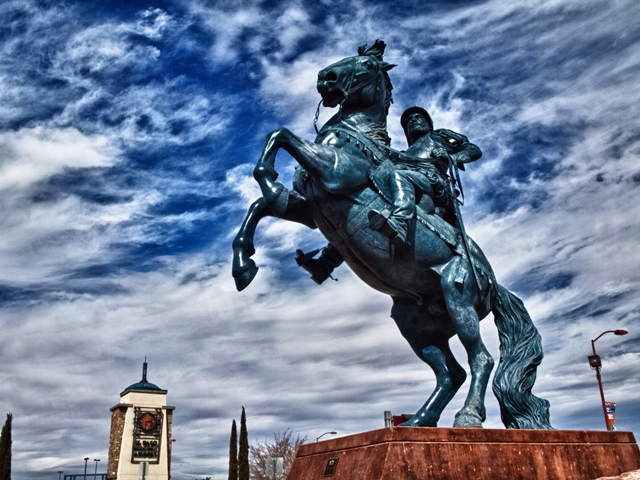
The Equestrian


The Equestrian is the world's largest bronze equestrian statue to date standing almost 40-foot tall.  It was dedicated on 21 April 2007 and the name of the artist is John Sherrill Houser (and Ethan Taliesin Houser).  This statue was originally named after Juan de Oñate (AKA Juan de y Oñate Salazar) which was a Spanish conquistador and explorer.  The stature was renamed to "The Equestrian" by the City Council in order to deter growing criticism of the sculpture.  Juan de Oñate, even by his own accounts, had subjected the people of Acoma and other pueblos to horrendous atrocities. 

February 23, 2011

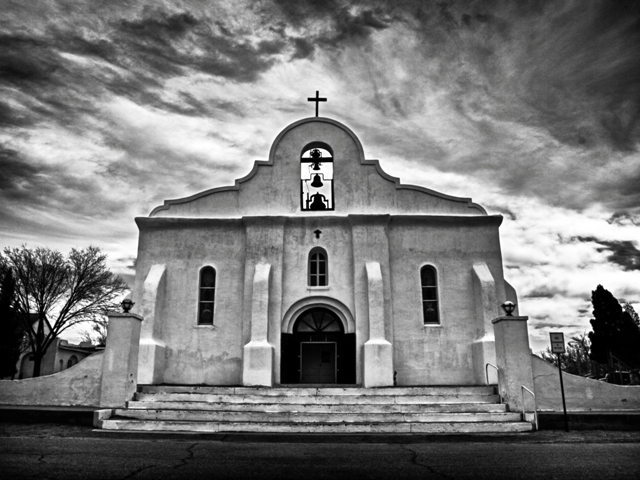
San Elizario Chapel (San Elizario)


The San Elizario Chapel was named for the 13th Century French patron of the military St. Elzear.  It was established as part of the Spanish Military Garrison of Presidio de San Elzeario (also Elceario, later Elizario).  It was moved to this location in 1789 from its original location, 37 miles to the southeast, after floods from the Rio Grande damaged the original chapel.  It was recorded as a Texas Historic Landmark in 1962.

February 15, 2011

Old Socorro Mission Cemetary (Socorro)


This cemetary is located behind the Old Socorro Mission in Socorro, TX, about 1/2 mile off Highway 80, and about 5 miles east of El Paso city limits. The Socorro Mission is part of the El Paso Mission Trail which was established in 1683 by the Franciscan Priests an is still in use today. The cemetary itself is small in size when compared to other cemetaries in the area, but at first glance it is noticeable that it is very old. The photo above depicts a couple of wooden crosses that did not even have a name associated with the graves.

February 13, 2011

Ysleta Mission (El Paso)


La Mision de Corpus Christ de San Antonio de la Ysleta del Sur
Photo in HDR (High Dynamic Range)

This mission is part of the El Paso Mission trail. It was established in 1680 and is the oldest mission in Texas that is still being used today. Owing its heritage to Pueblo traditions, Franciscan Missionaries, and Spanish Colonial life in Northern New Mexico. The Ysleta Mission was established by Antonio de Otermin and Fray Francisco de Ayeta.
This is one of three mission along the El Paso Mission trail. I really enjoyed taking photos of this mission. During the post-processing of the photos taken and trying of different techniques, it was the use of HDR that seem to work best.